


(English version below)
Tive o privilégio de ter estado ontem no Rothbard 100, no Porto. Uma celebração do centenário de Murray Rothbard, um homem que identificou verdades absolutas sobre como o mundo funciona, e foi sistematicamente ignorado por isso. Não é coincidência, nem azar. É estratégia.
Fernando Chiocca pôs o dedo na ferida logo a abrir: as ideias de Rothbard têm mais anos não adoptados do que o abolicionismo demorou a acabar com a escravatura. Mas há uma razão para isso, e não é porque Rothbard estava errado.
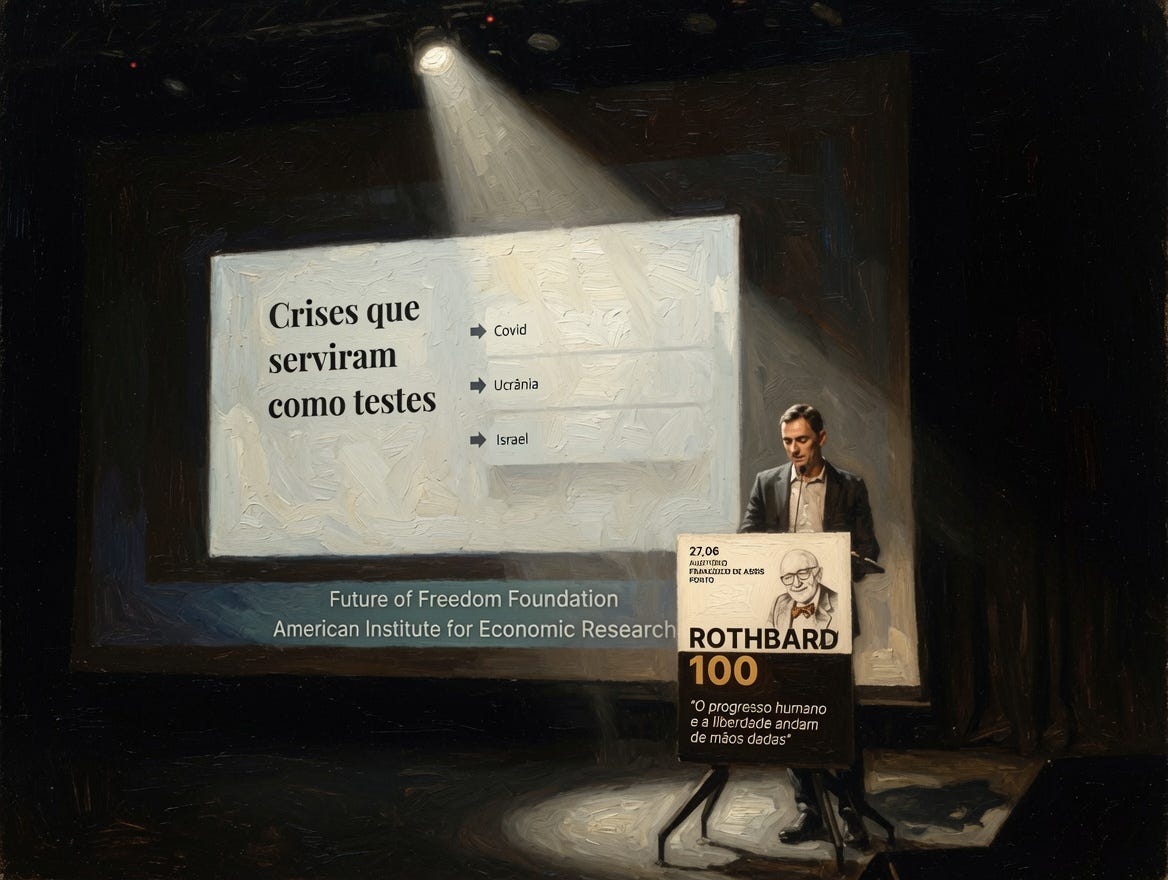
É porque ele estava demasiado certo.
O abolicionismo era uma ideia simples. Não podes apropriar-te do trabalho de outra pessoa a 100%. Tecnicamente, isso é parasitismo, em que o parasita acaba por destruir completamente o hospedeiro. A humanidade, depois de muita luta, aceitou isso. O que não aceitou foi o passo seguinte, que Rothbard teve a coragem de dar:
A taxa de parasitagem só pode ser zero.
Não 23%. Não 48%. Zero. Tudo o resto é escravatura com contrato. Parasitagem percentual. Em Portugal até têm a honestidade de publicar a tabela — chama-se tabela de IRS, e é literalmente um menu de quanto o Estado acha que te pode parasitar, dependendo de se produzes mais ou menos.
Claro que depois ainda levas com 23% de IVA em cima, e mais umas taxinhas por baixo, para garantir que sentes continuamente as grilhetas.
A escravatura não acabou. Foi regulamentada
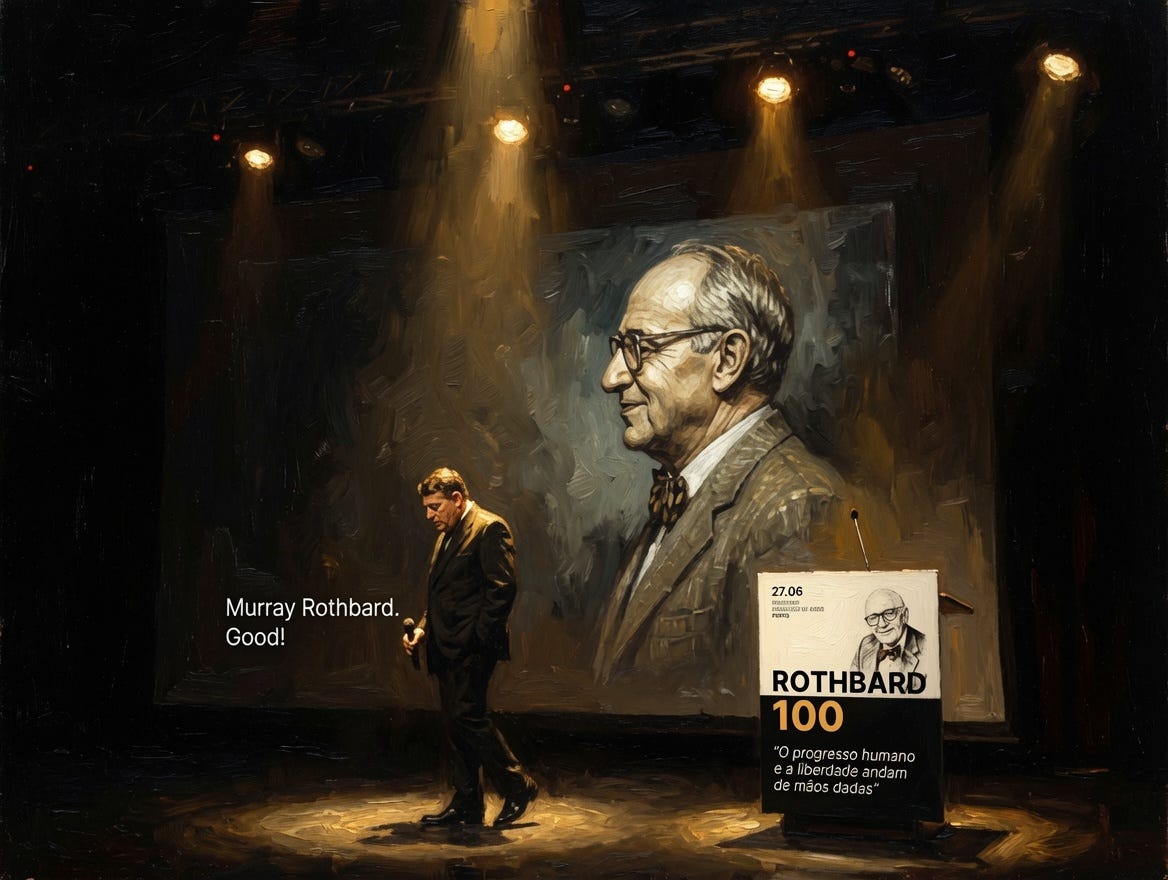
Luís Gomes e o professor Anxo Bastos explicaram outra verdade Rothbardiana que também não tem resposta: os monopólios não nascem do mercado, nascem do Estado. O culpado é sempre o mesmo.
Pergunta-te porque não há concorrência real nas telecomunicações, na televisão, na energia. Não é porque o mercado falhou, ou porque os empresários querem sugar o sangue dos seus clientes. A verdade é que os monopólios acontecem porque o Estado não deixa entrar mais ninguém. Protege quem já lá está, garante a sua fatia, mantém os preços artificialmente altos, e depois ainda cobra impostos sobre esses preços inflacionados. Rothbard identificou isto com precisão cirúrgica. Não é ensinado nas universidades, não aparece nos jornais, porque quem controla as universidades e os jornais (que são pagos pela mesma mão que parasita os cidadãos) vive muito bem com o arranjo actual.
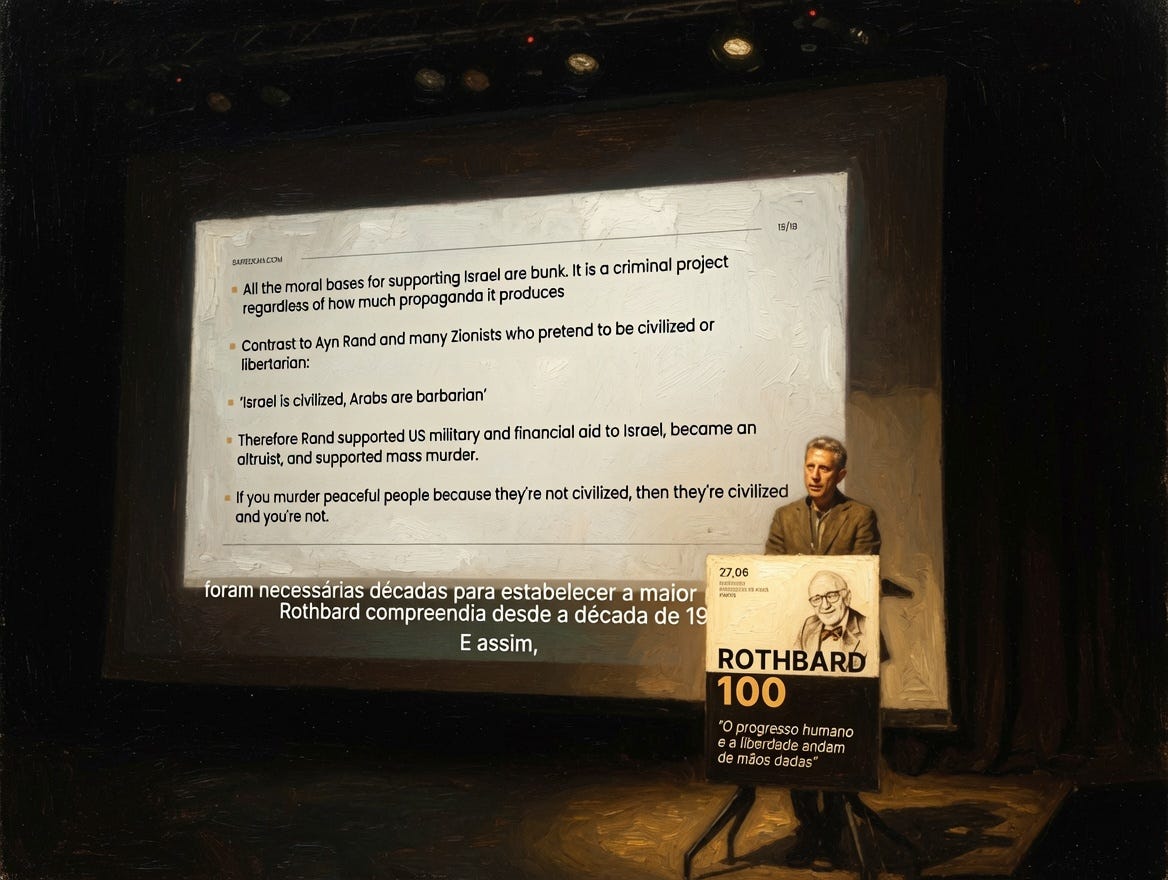
Saifedean Ammous trouxe ao palco o problema israelo-palestiniano, e a solução de Rothbard para o mesmo cabe numa única frase: respeito pela propriedade privada. A terra tinha donos, sempre teve. Vieram os mandatos ingleses, as doações de terras alheias, as expropriações, as limpezas étnicas, a colonização de províncias inteiras. Chamam-lhe colonatos, que é literalmente a palavra para terras conquistadas pela força — e dizem-no em voz alta, sem vergonha. Após a Segunda Guerra, as colónias europeias foram sendo devolvidas aos nativos. Israel é hoje a excepção única e solitária, a continuar a conquistar o que não é seu, amparado num mandato divino de há três mil anos que, curiosamente, tem mais peso que a propriedade privada. Rothbard era judeu, e era absolutamente claro: nenhum argumento religioso, étnico ou histórico justifica roubar a terra de quem lá vive. Povos que viveram em paz durante séculos tornaram-se inimigos por esta violação de um princípio simples. Princípios simples, quando violados, produzem catástrofes complexas.
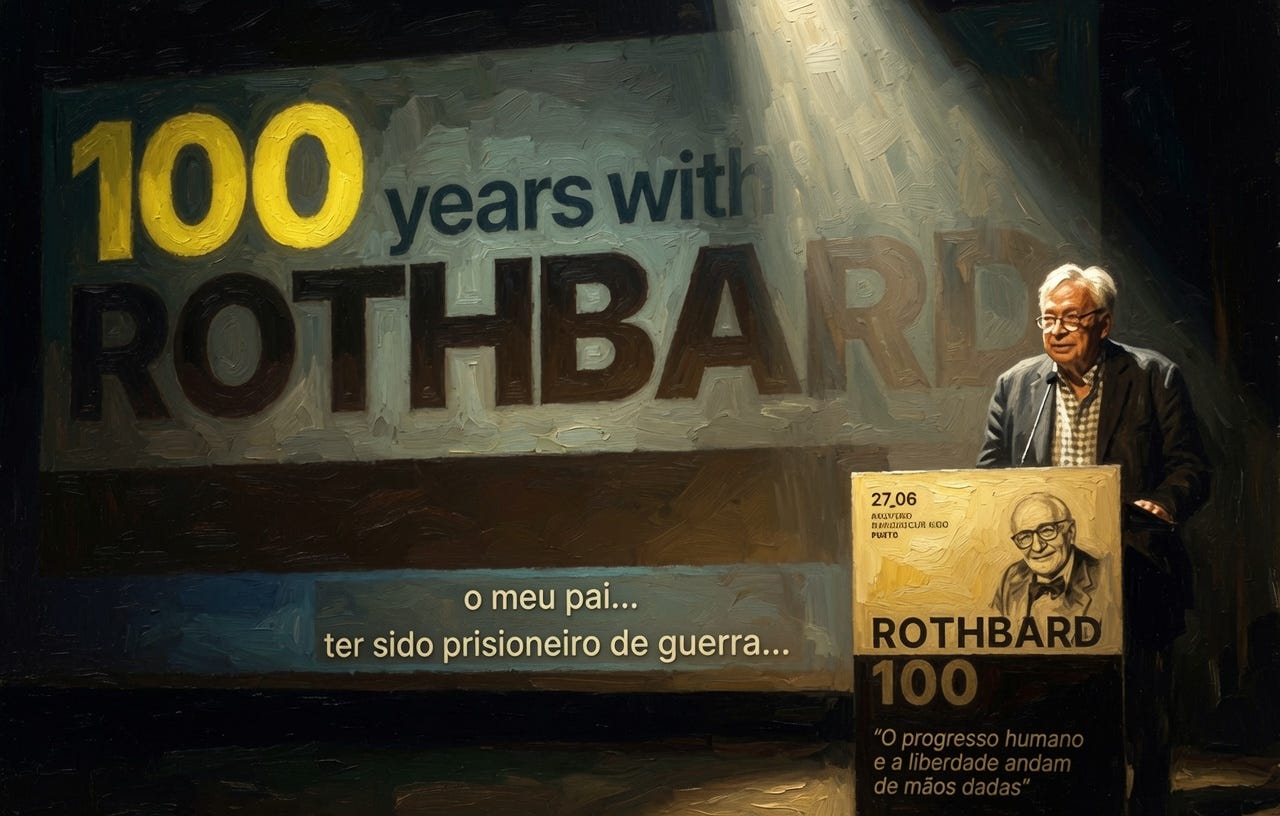
Hoppe falou do seu pai. Esteve num campo de concentração americano após a guerra, sem culpa formada, sem julgamento, sem crime. Uma verdade incómoda: os libertadores também fizeram campos de concentração. A ocupação americana da Europa, vendida como defesa colectiva e institucionalizada através da NATO, é imperialismo mas com melhores relações públicas. As colónias europeias foram devolvidas porque só pode haver um império, e o império americano não admite concorrência. Financia-se a imprimir dinheiro — mais uma das críticas de Rothbard, que argumentava, com razão inatacável, que a quantidade de moeda tem de ser fixa. Não pode ser inflacionada para financiar guerras. Os Estados Unidos atacaram mais países do que qualquer outro na história. Alguém pagou essa conta. Pagou com o poder de compra destruído, com a inflação, com a pobreza que aparece misteriosamente depois de muita impressão de dinheiro. E eles imprimem MUITO dinheiro.
O legado de Rothbard é inconveniente precisamente porque é irrefutável. Não lhe foi reconhecido o mérito em vida por covardia organizada — de quem vive confortavelmente a parasitar uma percentagem do trabalho alheio, a gerir o dinheiro dos outros, a produzir regulamentos que justificam o seu salário e mais nada. Foi menorizado, ignorado, tratado como curiosidade académica excêntrica. Nikola Tesla também foi. A verdade tem esse problema: não precisa de aprovação para continuar a ser verdade.
Vai demorar. Pode demorar cem anos, pode durar duzentos. Mas a mensagem de Rothbard é a única que aponta para uma humanidade que aproveita o seu potencial completo, sem ser taxada até à humilhação por uma classe crescente de pessoas que não produzem nada.
Não é uma mensagem para cobardes. Nunca foi.
Uma última palavra, e é a mais justa de todas.
Stephan Kinsella e Hans-Hermann Hoppe afirmaram que foi um dos melhores eventos libertários em que estiveram. Não eram amabilidades de circunstância — estas pessoas não perdem tempo com isso. A organização do Rothbard 100 foi um trabalho colectivo, feito na sua esmagadora maioria por voluntários, pessoas que deram o seu tempo sem contrapartida, porque acreditam em algo. Mas foi uma ideia de uma pessoa: Manuel Ogando. Decidiu fazer o que nunca tinha sido feito. O melhor evento libertário de sempre em Portugal, na Península Ibérica, na Europa, e provavelmente no mundo. Não é um exagero. É o que disse quem sabe do que fala.
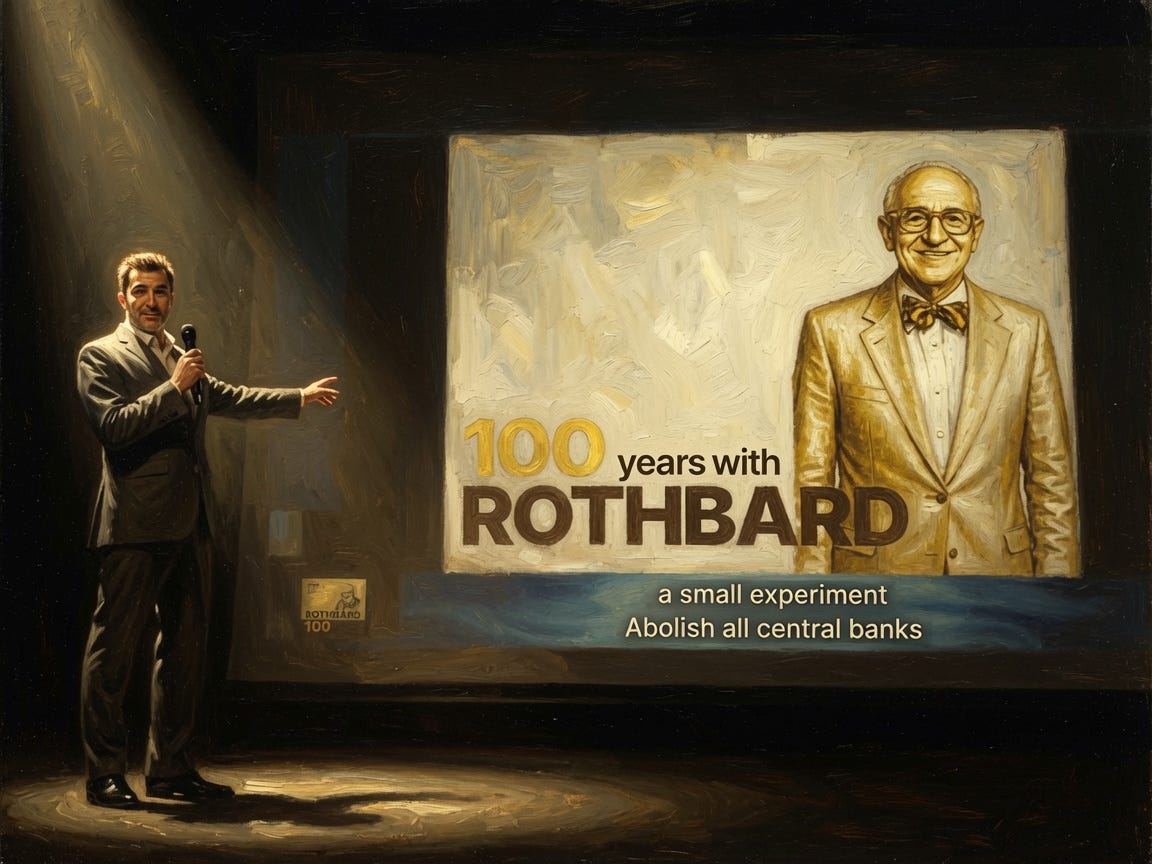
As ideias de Rothbard ficaram ontem mais vivas, porque foram entregues a uma geração nova, que já sente que o mundo não é bem como lhes contaram, que algumas coisas não encaixam, que as respostas oficiais não chegam. Muitas dessas respostas estão no trabalho de Murray Rothbard, e ontem essa geração encontrou-as numa sala no Porto.
Manuel Ogando conquistou um lugar na história do movimento libertário ao pensar e executar este evento. Todos os que amam a liberdade ficaram com uma dívida de gratidão — aos oradores, à organização, e ao homem que teve a audácia de querer fazer o melhor.
Um ENORME Muito obrigado a todos.
English version:
I had the privilege of attending Rothbard 100 in Porto yesterday. A celebration of the centenary of Murray Rothbard, a man who identified absolute truths about how the world works, and was systematically ignored for it. That is not acoincidence, or bad luck. It’s strategy.
Fernando Chiocca put his finger on it straight away: Rothbard’s ideas have gone unadopted for longer than it took abolitionism to end slavery. But there’s a reason for that, and it’s not because Rothbard was wrong.
It’s because he was too damn right.
Abolitionism was a simple idea. You cannot appropriate one hundred percent of another person’s labour. Technically, that’s parasitism — the kind where the parasite ends up destroying the host entirely. Humanity, after much struggle, accepted that. What it didn’t accept was the next step, which Rothbard had the courage to take:
The parasitism rate can only be zero.
Not 23%. Not 48%. Zero. Everything else is slavery with a contract. Percentual parasitism. In Portugal they even have the honesty to publish the table — it’s called the IRS tax bracket, and it is literally a menu of how much the State thinks it can parasite you, depending on whether you produce more or less. And then you still get hit with 23% VAT on top, plus a few little extra taxes underneath, just to make sure you feel the shackles continuously.
Slavery didn’t end. It was regulated.
Luís Gomes and Professor Anxo Bastos explained another Rothbardian truth that also has no answer: monopolies don’t come from the market, they come from the State. The culprit is always the same.
Ask yourself why there’s no real competition in telecoms, television, or energy. It’s not because the market failed, or because businessmen want to bleed their customers dry. The truth is that monopolies happen because the State won’t let anyone else in. It protects whoever is already there, guarantees their slice, keeps prices artificially high, and then still charges taxes on top of those inflated prices. Rothbard identified this with surgical precision. It isn’t taught at universities, it doesn’t appear in newspapers, because whoever controls the universities and the newspapers — paid by the same hand that parasites citizens — lives very comfortably with the current arrangement.
Saifedean Ammous brought to the stage the Israeli-Palestinian problem, and Rothbard’s solution fits in a single sentence: respect for private property. The land had owners — it always did. Then came the British mandates, the gifting of other people’s land, the expropriations, the ethnic cleansing, the colonisation of entire provinces. They call them settlements, which is literally the word for lands conquered by force — and they say it out loud, without shame. After the Second World War, European colonies were returned to their natives. Israel today is the sole and solitary exception, continuing to conquer what is not its own, backed by a divine mandate three thousand years old that, curiously, carries more weight than private property. Rothbard was Jewish, and he was absolutely clear: no religious, ethnic, or historical argument justifies stealing the land of those who live there. Peoples who lived in peace for centuries became enemies because of this violation of a simple principle. Simple principles, when violated, produce complex catastrophes.
Hoppe spoke about his father. He was held in an American concentration camp after the war, without charges, without trial, without crime. An uncomfortable truth: the liberators also built concentration camps. The American occupation of Europe, sold as collective defence and institutionalised through NATO, is imperialism with better public relations. European colonies were handed back because there can only be one empire, and the American empire tolerates no competition. It finances itself by printing money — another of Rothbard’s criticisms, who argued, with unanswerable logic, that the quantity of money must be fixed. It cannot be inflated to finance wars. The United States has attacked more countries than any other in history. Someone paid that bill. It was paid by destroying purchasing power, with inflation, with the poverty that appears mysteriously after a great deal of money printing. And they print a LOT of money.
Rothbard’s legacy is inconvenient precisely because it is irrefutable. He was denied recognition in his lifetime through organised cowardice — by those who live comfortably parasiting a percentage of other people’s work, managing other people’s money, producing regulations that justify their salary and nothing else. He was diminished, ignored, treated as an eccentric academic curiosity. So was Nikola Tesla. Truth has that problem: it doesn’t need approval to keep being true.
It will take time. It may take a hundred years, it may take two hundred. But Rothbard’s message is the only one that points toward a humanity that realizes its full potential, without being taxed to humiliation by a growing class of people who produce nothing.
It’s not a message for cowards. It never was.
One final word, and it’s the most deserved of all.
Stephan Kinsella and Hans-Hermann Hoppe said it was one of the best libertarian events they had ever attended. These were not polite remarks for the occasion — these people don’t waste time on those. The organisation of Rothbard 100 was a collective effort, carried out overwhelmingly by volunteers, people who offered their time without compensation, because they believe in something. But it was one person’s idea: Manuel Ogando. He decided to do what had never been done before. The best libertarian event ever held in Portugal, in the Iberian Peninsula, in Europe, and probably in the world. That’s not an exaggeration. It’s what was said by people who know what they’re talking about.
Rothbard’s ideas came alive yesterday, because they were handed to a new generation — one that already senses the world isn’t quite as they were told, that some things don’t add up, that the official answers aren’t enough. Many of those answers are in the work of Murray Rothbard, and yesterday that generation found them in a room in Porto.
Manuel Ogando earned his place in the history of the libertarian movement by conceiving and executing this event. Everyone who loves liberty is left with a debt of gratitude — to the speakers, to the organisation, and to the man who had the audacity to want to do the best.
A heartfelt and enormous thank you to all.
Pq será que para nós o que ali foi dito ontem é tão simples, lógico e o mais correto para a sã convivência e para outros utopia? Em conversa com alguém acho que existem 2 motivos principais maldade e inveja.
Esse é o cara que defendia aborto e venda de crianças?